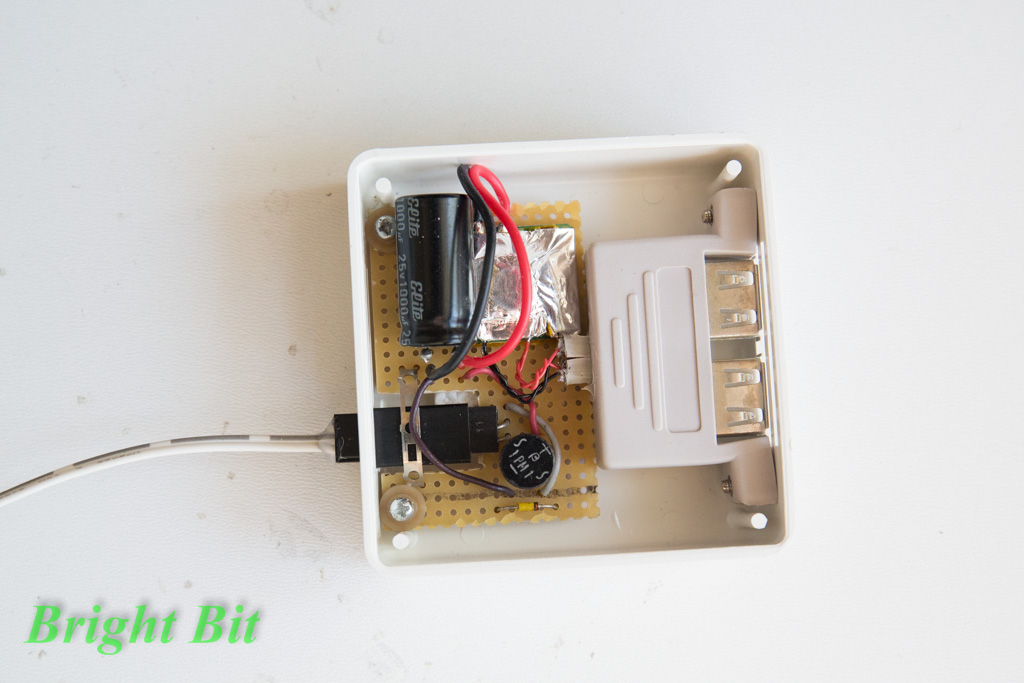
One day a biker friend of mine asked me to give him a solution for charging his phone from the bike's dynamo while on longer trips. Sounded pretty simple and a nice challenge for a low cost solution to be found.
His bike has a Shimano HB-NX70 dynamo that's nothing more than a alternating current generator rated for 6V and 3W. That voltage rating is an estimative figure though as it all depends on the wheel's speed so you can have much less when cycling slow or much more when speeding.
That being said, the solution? Whatever I had laying around as left overs or in the junkbox. A small plastic case, small piece of prototype PCB, a PC bracket with two USB connectors, a DC/DC converter (a.k.a. BEC in RC hobby world), and some discrete components: a rectifier diode bridge, a big fat filtering capacitor and a little protection with a zenner diode.
On the bike's original electrical instalation, the dynamo powers a head light together with a tail light. I had to open the head light anyway because it wasn't working so I pulled the AC from there.
The BEC starts operating at 6Vdc and goes all the way up to 23Vdc. I put it all together in a hurry and didn't give the time to pull up a schematic or do some multimeter work on the dynamo's output and how all things work together.
All I can say is that when the time came and we gave the charger a test spin, it worked, charging a phone with 600mA which is decent enough.
Showing posts with label charger. Show all posts
22 April, 2015
10 November, 2012
Mini Dynamo Hand Crank USB Emergency Charger review
OK, I admit it, I was geek enough to order one of these gizmos from ebay. It was only 1$ so no harm done, right? Well.. rolled myself laughing when I saw the same thing for 20$ (twice reduced, from 49.99 and then 25) on amazon here
. Luckily there's also another version here
for only 3.59$ :)) There are things about economy I just can't figure out.
But back to our little toy, if you haven't figure it out yet, let me explain it to you. It's a small crank driven dynamo that generates just enough juice to power an USB charging device like a cell phone, mp3 player or any other small type electronic, don't dream about tablets or other power hungry beasts. The key phrase there was "just enough" because it won't get to 100% but a charge or even a discharge to 10% and that's because the voltage out of this thing at "nominal" speed is lower than the standard 5V used on USB ports.


I knew from the start that it's a good for nothing toy but I couldn't help getting it and the first thing I did after unpacking was opening it up.

It's pretty amazing what 1$ can bring you: intricate lubricated plastic gears, a DC motor, a small PCB with the voltage stabilizer, not to mention the plastic housing and the strap. Pity for all the work those asian manufacturers put in it. Seeing that PCB made me think that maybe some of you want to see the schematic also and with a little help from digikey's Scheme It here you have it in all it's glory:
Quite rudimentary but it's good enough for the budget involved.
Features?
- It has a red LED that lights up when you spin the crank
- It also has a strap that you can.. do whatever you want with it
Pros:
- Gave me something to write about in this article
Cons:
- It's a "junk out of the box" kind of thing
But back to our little toy, if you haven't figure it out yet, let me explain it to you. It's a small crank driven dynamo that generates just enough juice to power an USB charging device like a cell phone, mp3 player or any other small type electronic, don't dream about tablets or other power hungry beasts. The key phrase there was "just enough" because it won't get to 100% but a charge or even a discharge to 10% and that's because the voltage out of this thing at "nominal" speed is lower than the standard 5V used on USB ports.


I knew from the start that it's a good for nothing toy but I couldn't help getting it and the first thing I did after unpacking was opening it up.

It's pretty amazing what 1$ can bring you: intricate lubricated plastic gears, a DC motor, a small PCB with the voltage stabilizer, not to mention the plastic housing and the strap. Pity for all the work those asian manufacturers put in it. Seeing that PCB made me think that maybe some of you want to see the schematic also and with a little help from digikey's Scheme It here you have it in all it's glory:
Quite rudimentary but it's good enough for the budget involved.
Features?
- It has a red LED that lights up when you spin the crank
- It also has a strap that you can.. do whatever you want with it
Pros:
- Gave me something to write about in this article
Cons:
- It's a "junk out of the box" kind of thing
Subscribe to:
Posts (Atom)